What Happens to Stocks During Wars — 80 Years of Data
I pulled S&P 500 data across 7 major military conflicts. The pattern was more consistent than I expected.
This article was originally published on StockCram. Read the full breakdown with charts, timelines, and sector data →
I’ve been getting the same question in my inbox all week: “Should I sell everything?”
Because that decision — more than anything — determines whether you miss the recovery.
With US-Iran tensions leading headlines in 2026, the anxiety is real. So I pulled 80 years of S&P 500 data across every major U.S. military conflict — from Pearl Harbor to the Russia-Ukraine invasion.
The answer surprised me.
Not because war was “good.” Because uncertainty was gone.
That single insight — that markets fear the buildup to war more than the war itself — changes how you read every conflict in the data.
The Data
Here’s what 80 years of market reactions actually show:
In 6 of 7 major military conflicts since 1941, the S&P 500 was higher 12 months after the conflict started — but the timing of the recovery is where things get interesting.
ConflictInitial Drawdown12-Month ReturnWorld War II-19.8%+15.5%Korean War-14.0%+28.8%Vietnam War-4.9%+10.2%Gulf War-19.9%+23.6%9/11 & Afghanistan-11.6%-16.8%Iraq Invasion-12.0%+30.1%Russia-Ukraine-5.3%+2.5%
Past performance does not indicate future results.
The sole exception? 9/11 — which coincided with the dot-com bust already in progress. The war amplified an existing downturn.
👉 See exactly when markets bottomed and how long each recovery took — the full breakdown covers all 7 conflicts with charts.
Why Markets Recover After War Begins
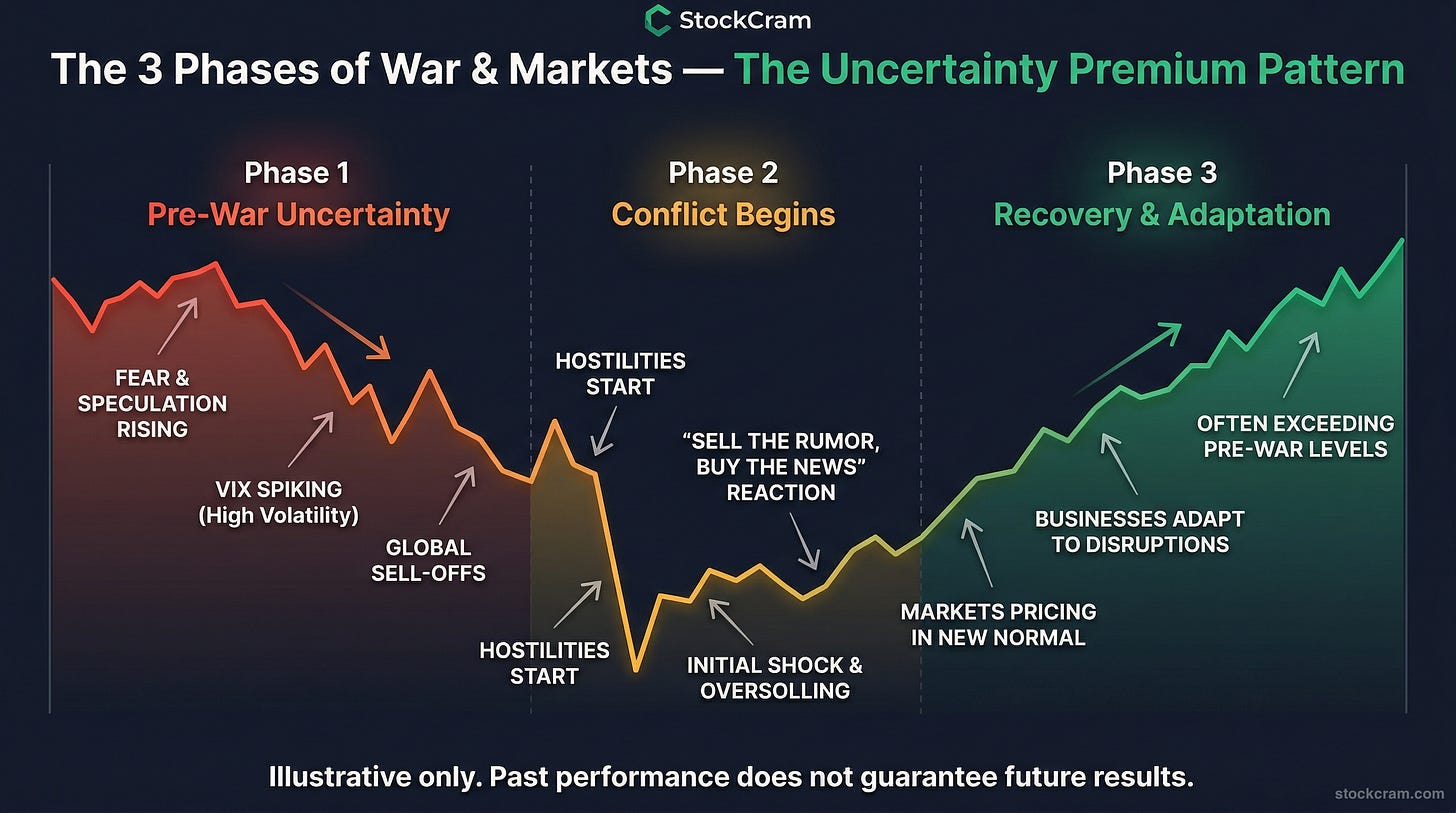
Financial historians call it the “uncertainty premium.” Markets struggle to price binary outcomes — will there be a war or not? Once military action begins, the biggest unknown resolves, and markets stabilize.
The Iraq invasion (2003) is the clearest example: the S&P 500 dropped ~12% during the months-long “will they or won’t they” buildup. Then the invasion started — and the market rallied ~30% over the next year.
This pattern shows up again and again across 80 years of data:
Pre-war fear → conflict stabilization → recovery. The pattern has repeated across every major conflict since WWII.
[
](https://substackcdn.com/image/fetch/$s_!hjqr!,f_auto,q_auto:good,fl_progressive:steep/https%3A%2F%2Fsubstack-post-media.s3.amazonaws.com%2Fpublic%2Fimages%2F372b6f38-eec3-4671-99df-bd7d2a8d0d54_2752x1536.png)
If There’s One Thing Markets Consistently Get Right During War — It’s Sector Rotation
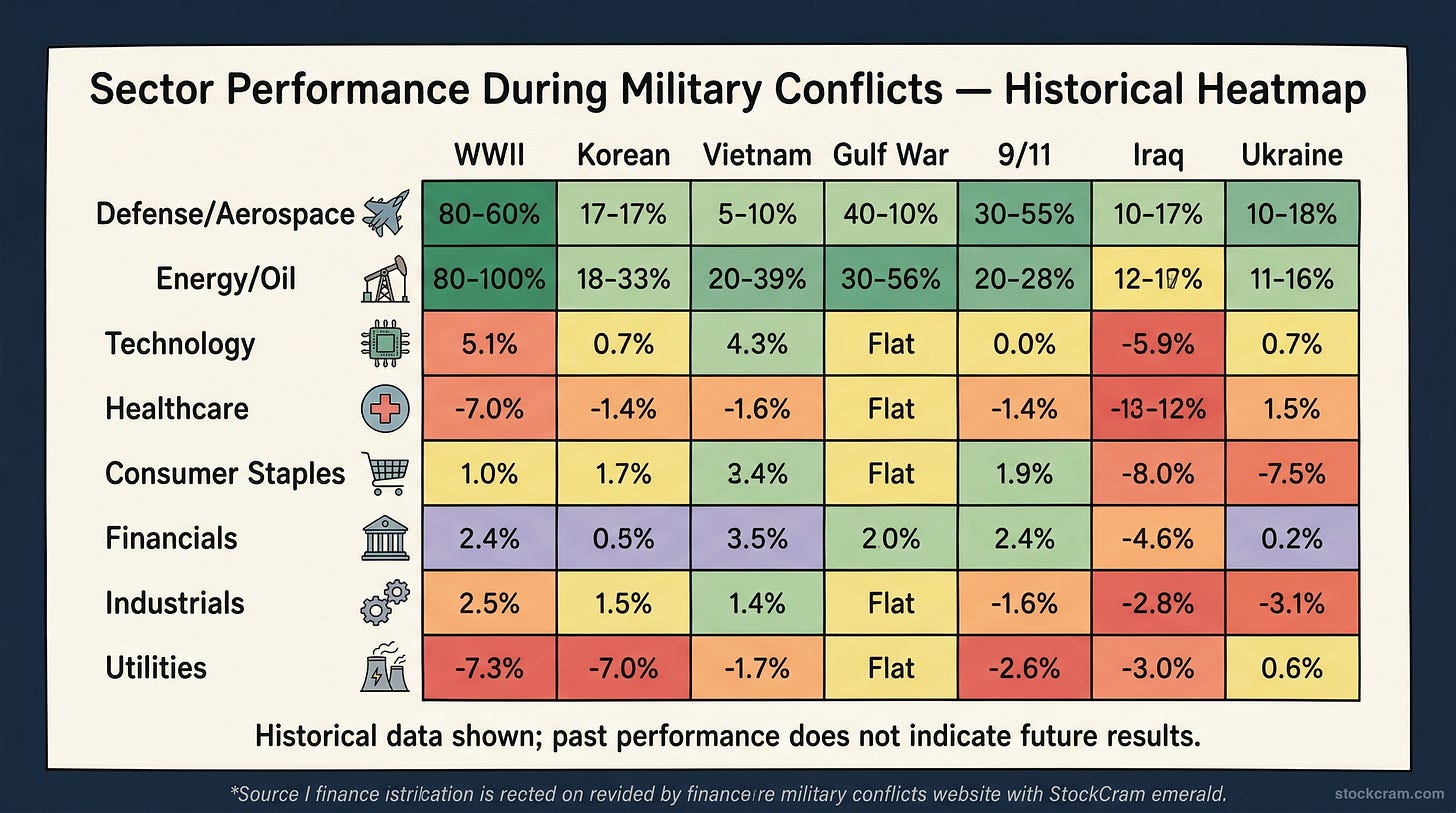
Across all seven conflicts, the same sectors won and lost:
Outperformers: Defense (LMT, RTX, NOC), Energy (XOM, CVX), Gold (GLD) Underperformers: Airlines (JETS), Consumer Discretionary (XLY), Import-Heavy Retail
In 2022 during Russia-Ukraine: Energy (XLE) surged +58% while the S&P 500 fell -19.4%. Lockheed Martin gained ~37%.
Here’s how that looked across all 7 conflicts:
Defense and energy outperformed in every major conflict since WWII. The consistency is striking.
[
](https://substackcdn.com/image/fetch/$s_!z2yS!,f_auto,q_auto:good,fl_progressive:steep/https%3A%2F%2Fsubstack-post-media.s3.amazonaws.com%2Fpublic%2Fimages%2F7a326d9b-c372-42c7-966e-52de44033698_2752x1536.png)
StockCram is not affiliated with any brokerage mentioned in this post.
What I’m Watching for Iran
The Gulf War (1990) is the closest template — oil-centered, Middle East-based, Strait of Hormuz implications. In 1990, the market fell 19.9%, oil doubled, then both reversed once Desert Storm began.
But 2026 is structurally different in ways that matter. The full analysis covers what’s changed — and what hasn’t.
The full analysis covers all 7 conflicts individually, with recovery timelines, sector heatmaps, and the specific data on when markets bottomed:
👉 See the full 80-year breakdown before the next headline hits
StockCram publishes educational stock market content every week. Visit StockCram →
StockCram is an educational platform, not a broker-dealer, investment adviser, or financial institution. Historical data shown; past performance does not indicate future results.
Thanks for reading StockCram! Every new Subscriber encourages me to write more posts.